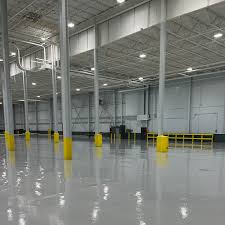
Scope Overview
Turnkey delivery for Painting and Concrete Coatings
We grind, shot-blast, and moisture-test slabs before applying epoxy or polyaspartic coatings, and we apply tilt-wall finish coats coordinated with the general contractor's punch list and the panel erector's schedule.
What Is Included
Epoxy and polyaspartic floor coating systems
Concrete grinding and shot-blast surface prep
Moisture vapor transmission testing before coating
Tilt-wall panel finish coats and texture matching
Dust-proofing and sealed concrete finishes
Curb, bollard, and dumpster enclosure painting
Color and sheen matching to approved boards
Coordination with GC punch list and erector schedule
Typical Project Scenarios
- Distribution center owner needing an epoxy floor system before racking installation
- General contractor needing tilt-wall exterior finish coats before a shopping center opening
- Manufacturing facility needing chemical-resistant flooring around process equipment
- Property owner recoating a warehouse floor that's showing wear after years of forklift traffic
Detailed Scope Narrative
Bare concrete floors and tilt-wall panels don't stay bare for long once a building goes into service. Warehouse floors need dust-proofing and chemical resistance, tilt-wall exteriors need a finish coat before a shopping center opens, and loading dock walls take a beating from forklift traffic that raw concrete can't hold up against on its own. We run painting and concrete coatings as a self-performed scope so the same crew that placed the slab or the panel can also finish it, instead of handing that step off to a separate trade and losing another week on the schedule.
Interior floor coatings cover the range most commercial and industrial owners in Dallas-Fort Worth ask for: epoxy systems for warehouse and manufacturing floors that need to resist forklift traffic, chemical spills, and constant foot traffic; polyaspartic and polyurea coatings where fast cure time matters because the building can't sit idle; and sealed or densified finishes for owners who want dust control without a full color system. We match the coating to the floor's actual use, not a default spec, because a distribution center's receiving dock and its office mezzanine don't need the same system.
Exterior work covers tilt-wall panel finish coats, which is often the last visible step before a shell reads as a finished building instead of a construction site. We coordinate paint scheduling with the general contractor's punch list and the panel erector's schedule so finish coats go on after caulking and joint sealant are complete, and we match texture and sheen specs against approved color boards before full mobilization. Striping-adjacent work like curb painting, bollard coating, and dumpster enclosure finishes is handled under this same scope.
Because concrete coatings depend on surface prep as much as the coating itself, we run our own grinding, shot-blasting, and moisture testing ahead of any coating application rather than trusting someone else's slab prep. A coating applied over a slab with high moisture vapor transmission fails within a year regardless of product quality, so moisture testing is a standard step on every interior floor coating job, not an upsell.
North Texas humidity swings make that testing step more than a formality. A slab poured in August and coated in November behaves differently than one poured and coated in the same season, and vapor drive changes with the water table and site drainage as much as with the concrete mix itself. We've seen coatings fail on projects where a previous contractor skipped testing to save a day on the schedule, and the redo cost far more than the test would have. On new pours, we build coating into the original schedule rather than treating it as an afterthought once the building is already occupied.
Common Questions
Frequently Asked Questions
- What floor coating do you recommend for a warehouse with forklift traffic?
- Epoxy or polyaspartic systems hold up best under forklift traffic and chemical exposure. Polyaspartic cures faster, which matters if the building needs to go back into service quickly.
- Do you paint tilt-wall exteriors?
- Yes. We apply finish coats to tilt-wall panels after joint sealant and caulking are complete, matched to approved color and texture specs, and we coordinate that scheduling directly with the general contractor's punch list.
- Do you test for moisture before coating a concrete floor?
- Yes, on every interior coating job. Moisture vapor transmission testing determines which coating system will actually hold, and skipping it is the most common reason floor coatings fail early.
- Can you coat a floor we didn't pour?
- Yes. We take on coating and painting scopes for slabs poured by other contractors, including surface prep, grinding, and moisture testing on existing concrete.